The Control Room in Your Hallway: Giving a Nottinghamshire UFH Manifold Room to Breathe
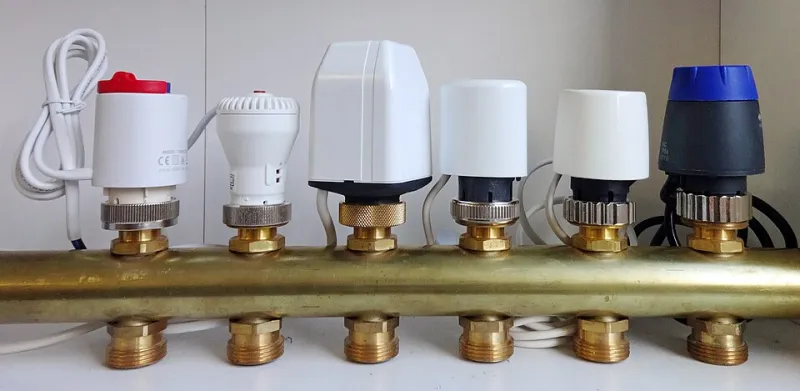
Photo: Harold2013, CC0, via Wikimedia Commons
Most Nottinghamshire homeowners spend weeks choosing floor coverings, thermostats and pipe spacing. Then the manifold turns up in a hallway cupboard, gets boxed in behind a shelf, and is not thought about again until something drips. That is a shame, because the manifold is the control room of the whole warm-floor system. It is the bit with the gauges, valves, actuators and small pipes that decide which room gets heat and how much. Give it a sensible home and it will quietly do its job for years. Bury it in a bad spot and every future service visit starts with an apology and a hunt for the stopcock.
What the manifold actually does
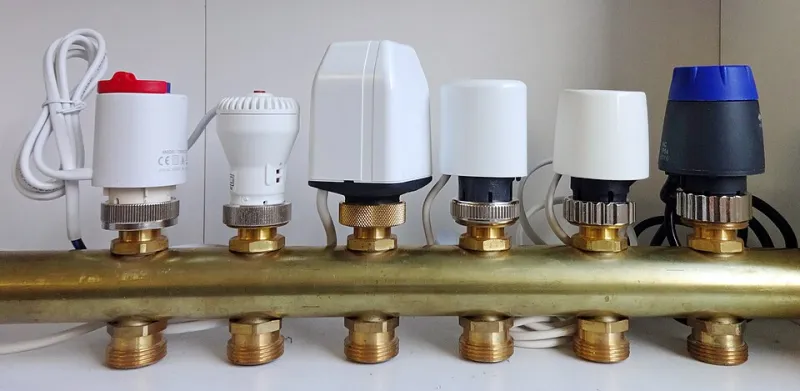
An underfloor heating manifold is a distribution hub. Warm water arrives from the heat source, gets blended to a safe temperature, and is then sent around separate loops under different rooms. Flow meters show how much water is moving. Actuators open and close each loop when a thermostat asks for heat. Isolation valves let an engineer work on one part without draining the whole house. None of this is glamorous, but all of it needs to be reachable by a human being with tools.
That is the key point. A manifold is not a sealed appliance like a boiler. It has moving parts, small seals, electrical actuators and gauges that need reading. It also has a habit of developing the occasional weep at the least convenient moment. The location needs to be planned with the same care as the boiler position, not treated as a leftover cupboard problem.
The cupboard test: can someone actually work in there?
Before the plasterboard goes on, stand in front of the proposed manifold cupboard and imagine a heating engineer kneeling there with a torch. Can they open the door fully? Can they see the labels without moving three coats and a hoover? Is there enough clear floor to kneel down and reach the lower valves? A good rule of thumb is to leave as much working space in front of the manifold as the room will allow, ideally around 600mm where possible. In a compact Nottinghamshire terrace, that may be tight, but it should still be a deliberate compromise rather than an accident.
The manifold also needs to be accessible without dismantling the kitchen. If the only way to reach it is to pull out a fridge or cut through a sealed panel, the design has failed. Access panels are fine if they are genuinely removable and clearly marked. They are not fine if they get tiled over, painted shut or hidden behind a fixed cabinet back.
Mistakes that show up years later
The most common manifold mistake is boxing it into a space with no thought for servicing. Shelves get built around it, coats get hung in front of it, and the pressure gauge disappears behind a stack of shoes. Another frequent problem is a lack of power and light. Actuators and pumps need a socket, and an engineer needs to see what they are doing. A dark cupboard with no nearby plug is a false economy.
Drainage and isolation matter too. If a valve needs replacing, where does the water go? A small drip tray or a sensible route to a drain can turn a drama into a minor job. Knowing where the isolation valves are, and labelling them clearly, is just as important. So is keeping the manifold away from areas where frost is likely, or where a leak would quietly damage a ceiling below. Under a kitchen sink is rarely a good home. A loft can work in some properties, but only if access is safe and the space is properly protected.
Labelling: the cheapest upgrade in the house
A labelled manifold is a gift to everyone who comes after you. Each loop should be marked with the room it serves, not just a number. Isolation valves should say what they isolate. The drain point, the power supply and any blending valve should be obvious. Take photographs before the cupboard is boxed in and keep them with the boiler paperwork. If you are the sort of homeowner who keeps a folder for the house, add a simple diagram showing which pipe goes where. It takes ten minutes and saves an hour of head-scratching later.
A simple maintenance routine
You do not need to become a heating engineer. A monthly glance is enough for most people. Check that the pressure gauge is where it should be, look for drips or green crust around joints, and make sure the cupboard is not so full that the manifold is invisible. Keep the area clear. If you hear a new noise, such as a pump humming differently or a valve clicking constantly, make a note and mention it at the next service. Know where the isolation valves are before you need them. That one piece of knowledge is worth more than any gadget.
Questions to ask your installer before the box goes on
Ask where exactly the manifold will sit and why. Ask how much clear working space will be left in front of it. Ask how you isolate it, where it drains, and whether there is power and light in the cupboard. Ask how the loops will be labelled and what documentation you will get at handover. Ask what happens if a leak develops: will it run into the cupboard, onto the floor, or through a ceiling? Finally, ask whether the design leaves room for future zones. A manifold that is full to capacity with no spare ports may be fine now, but it limits your options later.
The leak you do not want to meet in the dark
If a manifold leak does happen, the difference between a calm ten minutes and a ruined evening is usually access and knowledge. If the cupboard is crammed, you cannot see the leak. If the isolation valve is unlabelled, you waste time guessing. If there is no tray or safe drain route, water finds the nearest thing you care about. Planning the manifold space is not about expecting failure. It is about making the system easy to live with, easy to service and much less dramatic when something needs attention.
In Nottinghamshire homes, cupboard space is often at a premium. That makes it even more important to treat the manifold as a piece of equipment rather than an inconvenience. Give it room, light, labels and a clear route for water. Your future heating engineer, and your future self, will be grateful.