Small Room, Big Decision: Choosing Underfloor Heating for a Nottinghamshire Bathroom
Photo: Federal Bureau of Investigation, Public domain, via Wikimedia Commons
Ask ten Nottinghamshire homeowners where underfloor heating is really worth it and nine will say the bathroom. It is the one room where you walk about barefoot on cold tile at half six in the morning, and it is the one room where a small, cheap system can genuinely change how the house feels. That is the appeal. The trouble is that a bathroom is also the most awkward room in the house to heat this way, because it is tiny, it is wet, and it usually has a door that will not close once you add a few millimetres to the floor.
So this is not a piece about whether UFH is nice. It is about which version belongs in a bathroom in Beeston or Bingham, and when the answer is neither.
Start with the floor you have actually got
A ground-floor bathroom over a solid slab is a different job from a first-floor bathroom over timber joists, and a 1930s terrace in Carlton is different again from a new-build in Edwalton with insulation already in the floor zone.
Two practical questions decide most of it:
- Can you afford to lose floor height? Build-up is the number that kills bathroom plans, not cost.
- Is the room above a heated space or over a cold void, garage or porch? Heat wants to go down as well as up, and insulation boards are not optional.
If you cannot answer both, you are not ready to choose a system yet.
Electric mats: fast, simple, and better than their reputation
An electric mat or loose cable is the default choice for a bathroom and usually the right one. It is a thin element laid on insulated backer boards, skimmed over with flexible adhesive, then tiled. Total build-up is commonly 10 to 15mm including tile, which is often the difference between keeping your existing door and hanging a new one.
Warm-up is quick — typically 20 to 40 minutes for a tiled floor from cold, and noticeably faster if the boards underneath are decent. A 3 to 4 square metre bathroom with a 150 to 200W per square metre mat draws roughly 600 to 800W.
On 2026 electricity prices, budget around 24 to 26p per kWh. Run it for an hour in the morning and an hour in the evening and you are looking at 30 to 45p a day, so call it £9 to £14 a month through the colder half of the year. That assumes a timer and a floor thermostat doing their job; leave it on all day and the numbers stop being friendly.
Supply costs for a typical bathroom kit land somewhere between £250 and £450, a programmable thermostat adds £60 to £130, and a Part P registered electrician will want £200 to £400 to wire it in properly with an RCD-protected supply. All in, most Nottinghamshire bathrooms come out between £550 and £900.
Wet systems: the long game, with a threshold problem
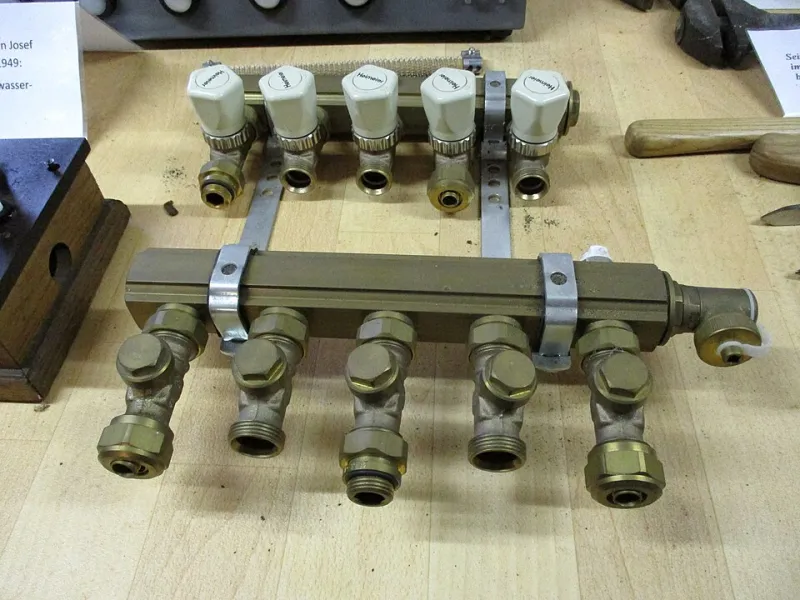
A wet circuit run from the main manifold gives you lower running costs per kWh of heat and no electrical load, and it feels wonderful underfoot. It also needs somewhere to put pipework and a fair bit of floor depth.
In a bathroom you have three realistic options:
- Screeded — 60mm or more of build-up. Fine on a ground floor during a full renovation, hopeless if you are keeping the door and the sanitaryware.
- Overlay or low-profile panels — around 15 to 20mm of panels plus tile, so roughly 25 to 30mm total. Workable, but you will be trimming doors and rethinking the threshold.
- Loose pipe in insulated trays — similar territory, cheaper materials, still needs depth.
Assuming your manifold is already there and has a spare port, adding a bathroom zone typically runs £900 to £1,600 including controls. If the manifold does not exist, you are not really buying bathroom heating any more — you are buying a system, and the conversation changes completely.
The rules bit nobody enjoys reading
Electric underfloor heating in a bathroom is not a DIY-friendly job, however good the YouTube video was.
- It needs 30mA RCD protection on the circuit. No exceptions, no 'it's on the same circuit as the lights'.
- Anything in a bathroom needs the right IP rating. Zone 2 wants at least IPX4; inside zone 1 you are looking at IPX5 or better, and many installers simply refuse to put controls there at all.
- The thermostat goes outside the zones, or in a form that is rated for the location.
- The work needs a certificate — a Minor Electrical Installation Works Certificate or a full EIC — from someone registered under Part P. Ask for it before the tiler arrives, not after.
For a wet circuit, the electrical side is smaller, but you still have a pump, a blending valve and controls, and you still want the design written down.
When the towel rail wins
Here is the bit installers rarely say out loud. In a bathroom under about 2.5 square metres, with a decent heated towel rail already on the wall, the case for UFH narrows considerably. A towel rail dries towels, takes the chill off the room and costs a fraction to buy. Underfloor heating does none of that better.
Similarly, if the floor is rarely bare — bath mats, rugs, a household that owns slippers — then a £600 mat is buying a feeling rather than solving a problem. And if your only realistic route is a mat over uninsulated boards with no thermal barrier, you will spend more warming the joists than the tiles.
A perfectly respectable middle path is a mat on a simple timer with a floor sensor, set to come on for an hour before you get up. No smart app, no zone controller, no per-room scheduling. It does 80% of the job for 60% of the money.
The honest verdict
For most Nottinghamshire bathrooms, an electric mat on insulated boards, fitted by a registered electrician, on a timer, is the sensible answer. Choose wet only if the floor is already being dug up, the manifold is close, and you are planning to stay put long enough for lower running costs to matter.
Get the build-up measured before you get attached to a system. Get the certificate when it is done. And if a quote for a four square metre bathroom lands at four figures with no explanation, ask what is actually being installed and why.